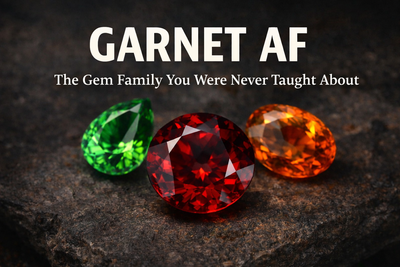
Garnet AF: The Gem Family You Were Never Taught About
Gallery Gems on 7th Jan 2026
Most people think garnet is red.
That assumption has done more damage to garnet’s reputation than any mall jewelry counter or birthstone chart ever could.
Because garnet isn’t a stone.
It’s a family.
Red just happened to be the member that showed up most often.
✦ Older Than Civilization’s Memory
Garnet didn’t spread because it was fashionable.
It spread because it survived.
It holds up under heat.
It holds up under pressure.
It survives travel, burial, recovery, and reuse.
That’s why garnet appears in Bronze Age graves, Roman signet rings, Viking trade goods, and medieval jewelry. It wasn’t chosen for romance. It was chosen because it worked.
Under torchlight, garnet doesn’t sparkle politely.
It glows.
That glow is why garnet became tied to blood, protection, vitality, and power — not as symbolism, but as observation.
✦ Carbuncle: The Biblical Garnet Debate
In ancient texts, garnet appears under several names. One of the most debated is carbuncle — a glowing red stone referenced in early Biblical and classical writings.
Scholars still debate whether every carbuncle was garnet.
What isn’t debated is this:
The stones described behave exactly like garnet does in low light.
Deep red.
Internal fire.
Alive-looking instead of decorative.
That’s why garnet followed warriors, rulers, and travelers. It was believed to guard against wounds, betrayal, and misfortune — because it endured when other stones failed.
✦ The Shortcut That Flattened Garnet
Modern jewelry prefers simple stories.
One color.
One name.
One price tier.
Garnet refused all three.
Its chemistry allows elements to swap freely, producing stones that share structure but behave very differently. Instead of explaining that complexity, the market simplified it.
Red became the default.
Everything else got ignored.
Once you call something “red garnet,” you don’t have to answer harder questions.
✦ The Garnet Family (Yes, It’s Complicated — Briefly)
This is the part most writing avoids.
Almandine.
Pyrope.
Grossular.
Andradite.
Spessartine.
These aren’t marketing names — they’re the backbone of the garnet family.
Same crystal structure.
Different chemistries.
Very different behavior.
Unlike ruby and sapphire, garnet doesn’t respect clean boundaries. These endmembers blend freely, creating overlap stones that confuse neat categories.
That’s how:
-
Rhodolite sits between almandine and pyrope
-
Tsavorite lives within the grossular family
-
Demantoid emerges from andradite with fire that embarrasses diamond
-
Hessonite glows warm instead of sparkling
- Spessartine lives on the pyrope–almandine edge of chaos, glowing mandarin to ember-orange depending on iron and manganese.
Is it spessartine? Is it “spessartite”? Gemologists argue, cutters shrug, and the stone just burns anyway.
(If you want the full fire story, we go deep in Spessartine AF: Ember in Stone.)
Garnet forms correctly for its environment, not predictably for the market.
✦ The “Blue Garnet” Problem (And Why Your Eyes Aren’t Wrong)
For centuries, gemology was confident about one thing:
Garnet does not come in blue.
Then a small group of garnets complicated the rule.
In real life — not labs, not lighting tricks — many color-change garnets appear blue, blue-green, or blue-violet to the human eye. Only when lighting changes, or when science steps in, do extra descriptors get added.
Gemology explains mechanisms.
Humans report experience.
To most people, these garnets look blue.
That forced labs — including GIA — to refine their language and accept that garnet can occupy blue-adjacent territory, even if it doesn’t stay there permanently.
Garnet didn’t break physics.
It broke assumptions.
✦ Demantoid: The Garnet That Makes Diamond Uncomfortable
Demantoid garnet has dispersion higher than diamond.
That’s not branding. That’s optics.
When cut well, demantoid throws warm, aggressive fire that’s impossible to ignore. Fine Russian demantoid with classic horsetail inclusions now sits firmly in high five-figure price territory per carat.
That alone should have ended the “cheap garnet” myth.
It didn’t — because most people were never told demantoid existed.
✦ Why Garnet Is More Fun Than It Gets Credit For
Garnet spans:
-
ancient religious symbolism
-
battlefield superstition
-
early global trade
-
modern collector markets
-
optical behavior that still surprises labs
It includes stones worn for protection, stones prized for fire, stones dismissed as “too brown,” and stones valuable enough to sit beside elite sapphires without apology.
That range isn’t chaos.
It’s character.
✦ Gallery Gems: Garnet, Treated Like a Family
At Gallery Gems, we don’t sell “red garnet.”
We identify garnet species correctly.
We explain why almandine behaves differently than grossular.
We respect hessonite’s glow as much as demantoid’s fire.
Garnet was never simple.
It was just oversimplified.
✦ Final Spark
Garnet has been called a carbuncle, a blood stone, a talisman, a trade good, a warrior’s companion, and a birthstone.
None of those names are wrong.
They’re just incomplete.
Garnet isn’t interesting because it’s red.
It’s interesting because it refuses to stay small.