
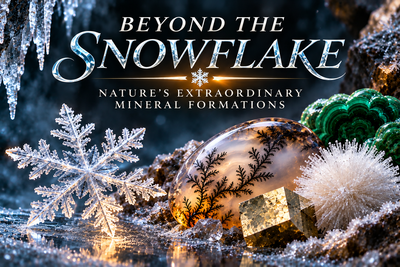
Beyond the Snowflake: Nature's Extraordinary Mineral Formations
Gallery Gems on 24th Nov 2026
From delicate crystalline snowballs to intricate patterns preserved within gemstones, nature is an extraordinary designer.
The familiar sixfold symmetry of a snowflake offers a beautiful example of natural crystal growth. But ice is only the beginning.
Throughout the mineral kingdom, nature produces remarkably precise metallic cubes, delicate fibrous spheres, intricate branching patterns, and extraordinary geometric formations.
Some are admired as mineral specimens, while others reveal their greatest beauty when transformed into gemstones and jewelry.
Nature's Extraordinary Architecture
The internal atomic arrangement of a mineral, combined with temperature, pressure, chemistry, and available growth space, influences its outward appearance. This characteristic form is known as crystal habit.
The diversity of these formations is remarkable:
- Okenite develops delicate, white fibrous clusters resembling miniature snowballs.
- Thomsonite can form colorful, radiating spheres.
- Pyrite produces remarkably precise metallic cubes.
- Axinite develops distinctive, wedge-shaped crystals.
- Malachite frequently exhibits rounded, grape-like formations known as botryoidal growth.
Crystals may develop individually, grow together in clusters, or form complex aggregates. Their naturally developed flat surfaces are called crystal faces, while their ends are known as terminations. Some crystals, such as doubly terminated quartz, develop natural terminations at both ends.
Growth conditions can also produce recessed, stepped faces known as hopper growth, or unusual intergrowths that dramatically alter a mineral's appearance.
When Crystals Break the Rules
Even familiar gemstones can develop surprisingly unusual crystal forms.
One fascinating example is the macle diamond, a naturally twinned crystal typically displaying a flattened triangular shape rather than the familiar octahedral form.
Twinning occurs when crystals or crystal domains share a specific crystallographic orientation. Chrysoberyl can develop remarkable six-rayed cyclic twins, gypsum produces elegant swallowtail twins, and staurolite is famous for its cross-shaped penetration twins.
These formations aren't departures from nature's rules, but extraordinary expressions of them.
For gemstone cutters, natural crystal morphology can influence cutting orientation, finished shape, and retained carat weight.
Snowflake Obsidian: Winter Preserved in Volcanic Glass
Born from rapidly cooled lava, obsidian is a natural volcanic glass rather than a crystalline mineral.
In snowflake obsidian, radiating crystalline formations containing cristobalite develop as portions of the glass crystallize.
These formations, known as spherulites, create distinctive white and gray patterns resembling scattered snowflakes against a dark background.
The striking natural contrast makes snowflake obsidian particularly attractive in rings, pendants, and other jewelry designs.
Dendritic Gemstones: Nature's Miniature Landscapes
Few gemstones capture the appearance of a winter landscape quite like dendritic agate and dendritic opal.
Branching mineral deposits, commonly composed of manganese or iron oxides, create intricate patterns resembling frost, trees, ferns, and distant forests.
Despite their organic appearance, these formations are mineral in origin rather than preserved plant material.
When thoughtfully cut and polished, dendritic gemstones can resemble miniature works of landscape art, each displaying its own natural composition.
Malachite and Agate: Beauty Beneath the Surface
The exterior of a mineral specimen doesn't always reveal the extraordinary patterns hidden within.
Malachite's rounded, botryoidal formations can reveal elaborate concentric circles and flowing green bands when cut and polished.
Agates display similarly captivating patterns created through silica deposition and variations in composition during their formation. Crazy lace agate is particularly admired for its intricate bands, curves, and contrasting colors.
The orientation of the cut can dramatically influence the finished appearance, revealing patterns that might otherwise remain hidden.
Trapiche Gemstones and Chiastolite: Nature's Geometry
Some gemstones display patterns so organized that they appear deliberately designed.
Trapiche emeralds are famous for their distinctive six-spoked patterns, associated with crystal growth sectors and the distribution of inclusions.
Comparable radial patterns can occur in certain rubies and other gemstones, although their formation mechanisms may differ.
Chiastolite, a variety of andalusite, contains dark inclusions arranged into a distinctive cross when the crystal is cut perpendicular to its length.
Unlike the external geometry of twinned crystals, these patterns are revealed within the gemstone itself.
Included Quartz: A World Within a Crystal
In many gemstones, inclusions are considered imperfections. In others, they are precisely what makes the material desirable.
Rutilated quartz contains slender rutile crystals resembling golden threads, delicate needles, or radiating starbursts. Tourmalinated quartz displays contrasting tourmaline crystals enclosed within its host.
Phantom quartz preserves outlines of earlier stages of crystal growth, while negative crystals are internal cavities whose shapes reflect crystallographic forms.
These remarkable internal features provide glimpses into the geological history of a gemstone while creating distinctive opportunities for jewelry design.
When Nature Becomes the Designer
Working with naturally patterned gemstones requires a thoughtful approach to cutting and polishing.
A lapidary must consider crystal orientation, inclusions, symmetry, contrast, and the distribution of natural patterns.
The placement of a dendritic landscape, the symmetry of a chiastolite cross, or the concentric bands of malachite can determine how a gemstone is shaped.
Even optical phenomena such as asterism in star sapphires and rubies depend on the relationship between naturally oriented inclusions and the direction of the cut.
Rather than concealing these characteristics, gemstone cutters and jewelry designers can celebrate them, creating pieces that showcase nature's original artistry.
Frequently Asked Questions
What is a crystal habit?
Crystal habit describes the characteristic external shape or growth appearance of a crystal or crystalline aggregate.
What is a macle diamond?
A macle is a naturally twinned diamond crystal, commonly displaying a flattened triangular form.
Are dendritic inclusions actually plants or fossils?
Generally, no. They commonly consist of branching mineral deposits that resemble organic growth.
What does botryoidal mean?
Botryoidal describes a rounded mineral growth habit resembling a cluster of grapes. Malachite and chalcedony are familiar examples.
Are naturally patterned gemstones treated?
Many develop their patterns naturally, although treatments such as dyeing can enhance certain materials. Known treatments should be properly disclosed.
Do inclusions reduce a gemstone's value?
Not necessarily. In materials such as rutilated quartz, dendritic agate, and trapiche emerald, distinctive inclusions can contribute significantly to their desirability.
Beyond the Ordinary
From the delicate crystalline snowballs of okenite to the triangular geometry of a macle diamond and the intricate landscapes within dendritic agate, nature's extraordinary formations extend far beyond the familiar snowflake.
Gemstone beauty isn't always defined by transparency, brilliance, or uniform color. Sometimes, it is the unusual growth, inclusions, and intricate patterns that make a gemstone truly exceptional.
Nature creates the design. The lapidary reveals it. Jewelry gives us the opportunity to wear it.
Discover more fascinating gemstone science, history, and natural wonders in the Gallery Gems Gemstone Guide.